There are a lot of mixed messages out there right now about where you should be investing your money for the strongest potential growth. If you have even glanced at your favorite news app lately, you know that the stock market is at an all-time high, new cryptocurrencies are appearing like the dandelions on your lawn, and trolls on subreddits are stirring things up and making headlines.
But here’s the thing… even though NFTs, art, wine, and even sports cards are seeing massive increases in activity, doesn’t mean that investing in them will make you into a millionaire overnight! Let’s break down why real estate, and the opportunity we have available for you right now (scroll to the bottom), is the most solid investment you can make in 2021.
1. Real Estate Investing is Easier to Analyze Than Other Forms of Investment
- Real estate investment has a much simpler and more basic financial analysis than the stock market or other alternative investment classes: Revenue received, less expenses and debt services, are the basic metrics utilized to analyze real estate.
- The financial performance of the underlying asset is much clearer than evaluating the performance of a stock.
- Stock financial performance is becoming less about the performance of the underlying company, and more about the demand for such stocks. This requires significant assumptions as to the performance, as the stock performance is not directly tied to the company’s underlying performance.
2. Exert More Control When You Invest in Real Estate
- Real estate is a physical asset. It is tangible and gives a greater sense of control. Owning small slivers of a company (stock) assume the continued performance of the market, as well as the company that issued the stocks. With real estate investment partnerships, you have control (voting rights) and access to decision-makers. By becoming a member of the entity that owns the real estate you become bound by the operating agreement. That operating agreement gives you voting rights. You also have access to communicate and discuss the property with the decision-makers. Buying stocks does not give you this benefit. You are subject to the decisions made by the company and do not have the same level of access.
- Real estate is not subject to new business ventures and operations that could harm financial performance. A rental property is just that – a rental. There is not a new line of business that could result in complete failure. Property will not surprise you by rolling out a “New Coke” (a great analogy for a failed line of business), whereas operating businesses in which you own stock could indeed launch a new line or approach to business that completely fails.
3. Real Estate Offers Tax Benefits and an Inflation Hedge
- Real estate investment benefits from a number of tax advantages. For example, depreciation aids in offsetting principal pay downs of any loans (which are not tax-deductible). Deprecation is a non-cash taxable expense that reduces the income tax associated with net cash flow from the property.
- Recapitalization strategies can provide access to “trapped equity” without triggering income tax impacts.
- Real estate serves as a hedge against inflation as rents and values typically increase as inflation increases.
4. Real Estate is Not Subject to Disruption (or Emotions)
- Real estate is not subject to shifts in consumer desires, emotional changes, Public Relations issues, technological advancements, or other “disrupters” that can impact publicly traded companies. Check out a perfect example of what can happen here.
- No advancement in technology can eliminate the need for people to have a “roof over their head.” Real estate is real estate is real estate.
- Private Equity and Venture Capital cannot introduce “disruptive alternatives” to the business. Real estate has been and will continue to be the same: providing people with a place to live and work.
- Stocks can fluctuate substantially in value day-to-day. This can lead to emotional decision-making and reactionary decisions. Real estate is not subject to the same emotional whims as stock market investing, nor is it subject to the collective emotions of market participants.
- While real estate is generally illiquid investment, it protects against the emotional reaction and poor decision-making that come with an emotional response.
5. Real Estate Performs Even if the Stock Market Doesn’t
- Real estate is a long-term investment driven by the underlying financial metrics of the property itself. It is not subject to the same impacts as stocks, which can see massive daily “swings” in value.
- If the stock market is “down” even strong performing companies can see the stock values dip. Because the overall “market” is responding pretty much the same way. Stocks tend to move in concert with each other.
- Real estate is highly localized. Thus if the local market is “down” in Dallas, it has zero impact on the local market in Boston. Whereas a “down” stock market, impacts the entire stock market on a national level.
6. Real Estate has a Higher Barrier to Entry Market
- Real estate can be expensive to invest in. That’s a good thing. If it were easy to invest, everyone would do it, and that would erode performance.
- Anyone can invest in the stock market. Online brokerages, apps, and a slew of other platforms allow for anyone to gain access to investing in the stock market.
- Real estate itself serves as a barrier to entry – as there is only so much real estate that exists. Investing in an apartment building in a great performing local market is limited to the amount of the offering or the purchase price. Only so many people can access that. For stocks, there are unlimited options, and to some extent, they are all available all of the time.
7. The Stock Market (and Other Alternative Assets) are Overpriced
- There was about $6 trillion in pandemic relief money. A huge portion of that either directly or indirectly went into the stock market.
- This massive influx of cash has caused the market to continue to perform, but largely based on this influx of cash, and not attributable to the overall economic performance of companies.
- Alternative investments are also (arguably) well overpriced. Bitcoin (which is difficult for most people to understand) and other cryptocurrencies are up several thousand percent in the last few years. Dogecoin (which the founders have said is literally a joke) has a larger market cap than Ford. While these “buzzy” options may create short-term value, the long term is far more in question with strong indicators that at some point the music will stop, and small retail investors will be stuck holding the bag.
- NFTs, art, wine, and even sports cards are seeing massive increases in activity recently. This may be attributable to the lack of viable “typical” investments, or perhaps the belief of some retail investors that these will lead to “overnight millionaires”. While this may hold true for a very select few, the reality is that the vast majority of people will not find the proverbial lottery ticket they are seeking.
To sum it up, now is the time to start looking for your next real estate investment! We have the perfect investment opportunity available for you in the hottest housing market in Vermont.
Your Next Investment Opportunity is Here
Check Out Our Multi-Family Building in the Hottest Market in Vermont
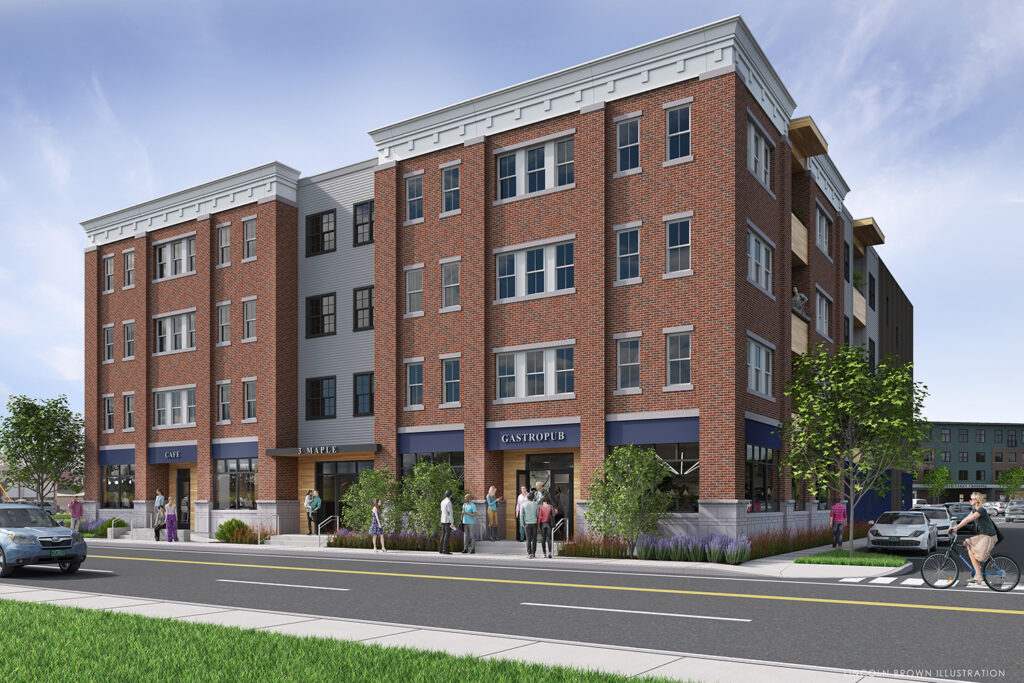
The Chittenden County real estate market is highlighted by low inventory, rising values, and significant demand. Essex, Vermont is in the heart of Chittenden County, which is the social, cultural, and economic hub of the state of Vermont. With the influx of out-of-state buyers and remote workers, Chittenden County is seeing a major home-buying boom. In an already tight housing market, the demand for rentals is increasing. Plus, there are many benefits to investing in multi-family properties.
The property projects to produce a 13% annualized return over 10 years. When sitting with a financial advisor they will run stock market performance based on an assumption of 8%. Please note that projected returns are not guaranteed and investments are subject to risks.
- The property, 3 Maple, is a 30 unit mixed-use asset with ground-floor commercial space.
- Chittenden County residential rental vacancy rates have been hovering in the 2-2.5% range (a healthy market is 5%) – which reflects the lack of inventory vs. the demand in the local market. This lack of inventory puts upward pressure on rental rates. This is not exactly ideal if you are looking to buy or rent, but is excellent if you are a real estate investor.
- The property projects to produce a 13% annualized return over 10 years. When sitting with a financial advisor they will run stock market performance based on an assumption of 8%. Please note that projected returns are not guaranteed and investments are subject to risks.
Ready to invest? Please get in touch by emailing me at kem@blackrockus.com. You can find more info for investors here.